Executive Summary
As India faces a fresh rise in COVID-19 cases, especially in states like Kerala, Maharashtra, and Delhi, the healthcare system must be prepared to detect respiratory deterioration early—even before symptoms become obvious. Many patients continue to present with silent hypoxemia, where standard SpO₂ readings fail to reflect the severity of gas exchange impairment.
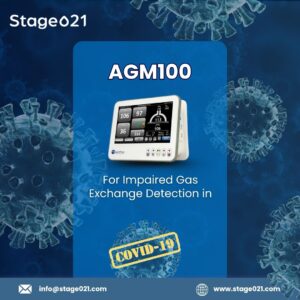
This blog explores how the MediPines AGM100, an FDA-cleared, portable, non-invasive device, enables real-time assessment of key pulmonary parameters such as oxygen deficit, alveolar oxygen (PAO₂), and end-tidal CO₂ (EtCO₂). Drawing on clinical evidence—including recent peer-reviewed studies—it demonstrates how AGM100 identifies ventilation-perfusion (V/Q) mismatch more accurately than traditional tools.
For India’s resource-constrained settings, AGM100 offers a game-changing advantage in managing COVID-19, COPD, Asthma, and other respiratory illnesses. The blog outlines the current epidemiological trends in India, showcases AGM100’s clinical and operational benefits, and advocates for its integration into COVID-19 triage and chronic respiratory disease management protocols.
Introduction
The COVID-19 pandemic challenged global healthcare systems and exposed a critical gap in our ability to monitor gas exchange efficiently. Patients often presented with dangerously low oxygen levels without corresponding symptoms—a phenomenon now widely referred to as silent hypoxemia. This clinical presentation prompted the need for advanced, non-invasive technologies capable of identifying impaired gas exchange more accurately and rapidly.
One such innovation is the MediPines AGM100, a portable, FDA-cleared device that provides real-time data on a patient’s pulmonary gas exchange efficiency. The AGM100 offers significant value not just for COVID-19 triage, but also in the management of COPD, Asthma, and other respiratory conditions involving compromised ventilation and perfusion.
Rising COVID-19 Cases in India: A Renewed Need for Vigilance
As of May 2025, India is witnessing a fresh rise in COVID-19 infections, with active cases crossing the 1,000-mark nationwide. This resurgence is fueled by new sub-variants including JN.1, LF.7, and NB.18, which are exhibiting milder symptoms but posing risks due to their fast transmission and stealthy onset.
State-wise Snapshot (as per latest reports):
-
Kerala: Highest active cases, accounting for nearly 50% of the national tally.
-
Maharashtra: Reported a sharp increase with daily cases in double digits.
-
Delhi: Crossed the 100 active case mark recently.
-
Tamil Nadu & Karnataka: Monitoring clusters, especially in urban centers.
Source: The Economic Times
The new variants often present without fever or obvious respiratory distress, making silent hypoxemia detection even more critical. Reliance on SpO₂ monitoring alone may delay clinical intervention, especially in high-risk or elderly populations.
AGM100: A Timely Solution for Indian Healthcare Providers
The AGM100 is uniquely positioned to serve the current needs of Indian hospitals, emergency departments, and even primary care centers. Its ability to provide non-invasive, real-time gas exchange measurements makes it indispensable in early detection and triage, particularly when:
-
Symptoms are mild or atypical
-
SpO₂ appears normal despite underlying impairment
-
Facilities lack rapid access to arterial blood gas (ABG) testing
Key Features for Indian Settings:
Portable & Battery Operated – Ideal for use in rural clinics and mobile units.
Rapid Readouts (under 2 minutes) – Supports overburdened ERs and triage teams.
No Need for Lab Infrastructure – Cuts reliance on ABG and lab personnel.
Early Warning System – Helps clinicians intervene before deterioration.
As India’s healthcare system prepares for potential waves or regional outbreaks, integrating AGM100 into COVID-19 triage protocols could prevent unnecessary hospitalizations and reduce ICU loads.
Understanding Gas Exchange and Why It Matters
Gas exchange is the process by which oxygen enters the bloodstream and carbon dioxide is expelled through the lungs. This delicate balance hinges on:
-
Ventilation – The air reaching the alveoli.
-
Perfusion – The blood flow in pulmonary capillaries.
When either component is impaired, a ventilation-perfusion (V/Q) mismatch occurs. This is a hallmark of many respiratory diseases, including:
-
COVID-19
-
COPD
-
Asthma
-
Interstitial Lung Disease
The oxygen deficit—a key metric measured by the AGM100—quantifies the difference between alveolar and arterial oxygen levels, revealing gas exchange abnormalities before standard monitoring tools do.
Clinical Evidence: AGM100 in COVID-19
A peer-reviewed study in the Journal of Clinical Medicine (PubMed: 37834847) demonstrated the AGM100’s ability to:
-
Detect oxygen deficits more accurately than pulse oximetry
-
Predict hospital admissions and oxygen therapy needs
-
Support early triage of COVID-19 patients, including those with silent hypoxemia
These advantages make it not only relevant but essential in the Indian healthcare setting, where clinical decision-making often happens in resource-constrained environments.
Applications Beyond COVID-19
COPD (Chronic Obstructive Pulmonary Disease)
India ranks second globally in COPD burden. The AGM100 allows clinicians to track gas exchange efficiency and CO₂ retention, helping prevent exacerbations and manage chronic airflow obstruction.
Asthma
In asthma cases, particularly in children or elderly patients, the device offers a window into alveolar oxygen levels, which may not be reflected in SpO₂ readings during an attack.
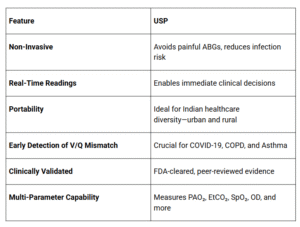
Let us now look at the USPs of MediPines AGM100:
Final Thoughts: Redefining Respiratory Diagnostics in a Post-Pandemic India
The ongoing rise in COVID-19 cases across Indian states, along with the country’s significant burden of chronic respiratory diseases like COPD and Asthma, highlights an urgent need for scalable, accurate, and accessible pulmonary assessment tools. Traditional diagnostic approaches—such as pulse oximetry and arterial blood gas (ABG) testing—either fall short in sensitivity or are too invasive and resource-dependent to be viable at scale, especially in semi-urban and rural India.
This is where the MediPines AGM100 stands out as a transformative innovation. It bridges the gap between clinical need and diagnostic accessibility by offering real-time, non-invasive insights into pulmonary gas exchange. Its ability to detect oxygen deficit, ventilation-perfusion mismatch, and alveolar oxygen levels without requiring a blood draw makes it ideal for today’s healthcare landscape—where early detection, portability, and rapid triage are more important than ever.
Moreover, in a country like India—where healthcare systems often function under high patient volumes, limited ABG infrastructure, and diverse geography—the AGM100 offers a rare combination of clinical precision and practical deployment. Whether it’s being used in an ICU, emergency department, outpatient respiratory clinic, or even in mobile health units, the device empowers healthcare professionals with critical physiological data that was previously inaccessible outside a lab setting.
The importance of gas exchange analysis extends beyond COVID-19. As India continues to combat air pollution, urbanization-related respiratory issues, and a growing elderly population, a forward-looking respiratory diagnostic strategy must include tools like the AGM100. Its relevance is not just temporary or pandemic-specific—it represents the next standard of care in how we evaluate and manage respiratory dysfunction across a wide spectrum of diseases.
In summary, the AGM100 is not just a device—it’s a diagnostic revolution. By enabling faster, safer, and more informed decisions, it aligns with India’s broader healthcare goals of improving outcomes, reducing burden on tertiary care, and increasing access to high-quality diagnostics in both urban and rural settings.
For Indian clinicians and healthcare administrators looking to build future-ready respiratory care protocols, adopting the AGM100 is a step toward early detection, better outcomes, and ultimately—saving lives.
To schedule a demo of the AGM100, please write to us at info@stage021.com.
 By
By