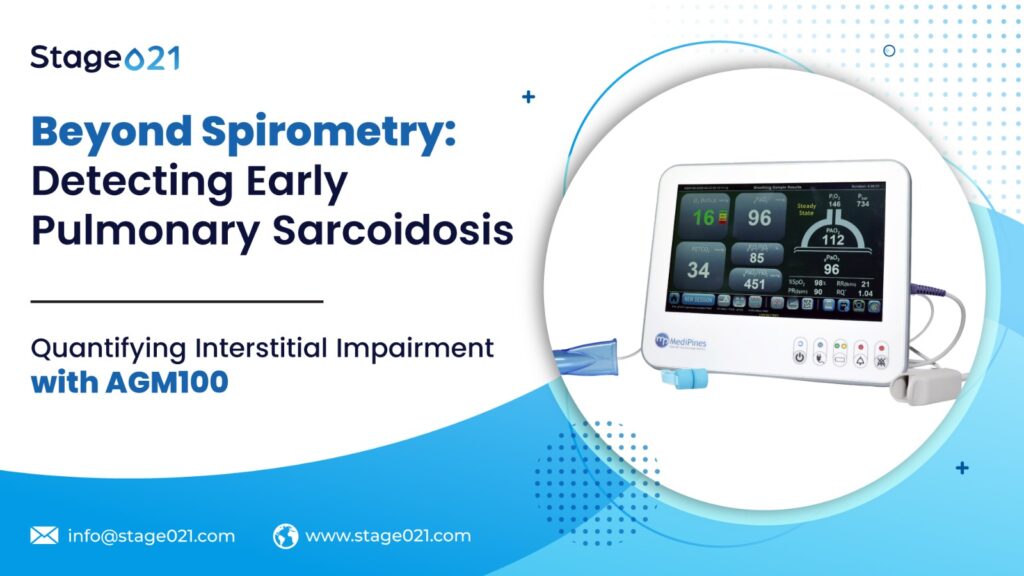
Early Sarcoidosis Detection via Non-Invasive Gas Exchange
Executive Summary
Pulmonary sarcoidosis remains a diagnostic challenge, particularly in its early phases (Scadding Stage I and II), where structural damage has not yet manifested in lung volume loss. Conventional diagnostic pathways, relying heavily on spirometry and chest radiography, often suffer from “diagnostic latency,” failing to identify the disease until it progresses to irreversible fibrosis.
The clinical integration of non-invasive gas exchange assessment, specifically utilizing the MediPines AGM100®, offers a paradigm shift. By quantifying the Oxygen Deficit (OD), a high-fidelity, non-invasive surrogate for the alveolar-arterial gradient (A-aDO2), clinicians can now detect subclinical gas exchange impairment and ventilation-perfusion (V/Q) mismatch at the point of care. This methodology facilitates early intervention during the inflammatory, reversible stage of the disease, providing a more sensitive alternative to mechanical lung function tests.
Pathophysiological Basis of Diagnostic Latency in Sarcoidosis
The hallmark of pulmonary sarcoidosis is the formation of non-caseating granulomas along the perilymphatic distribution. In early disease progression:
-
Interstitial Thickening: Granulomatous infiltration occurs within the alveolar-capillary membrane, increasing the physical distance for gas diffusion without necessarily reducing total lung capacity.
-
V/Q Mismatch: Small-vessel vasculitis and peribronchiolar granulomas disrupt the optimal matching of ventilation to perfusion.
-
The “Silent” Phase: Because airway resistance and total lung volume may remain unaffected in Stage I, Spirometry (FVC/FEV1) frequently yields results within the 80–120% predicted range, masking active physiological deterioration.
Comparative Analysis of Diagnostic Modalities
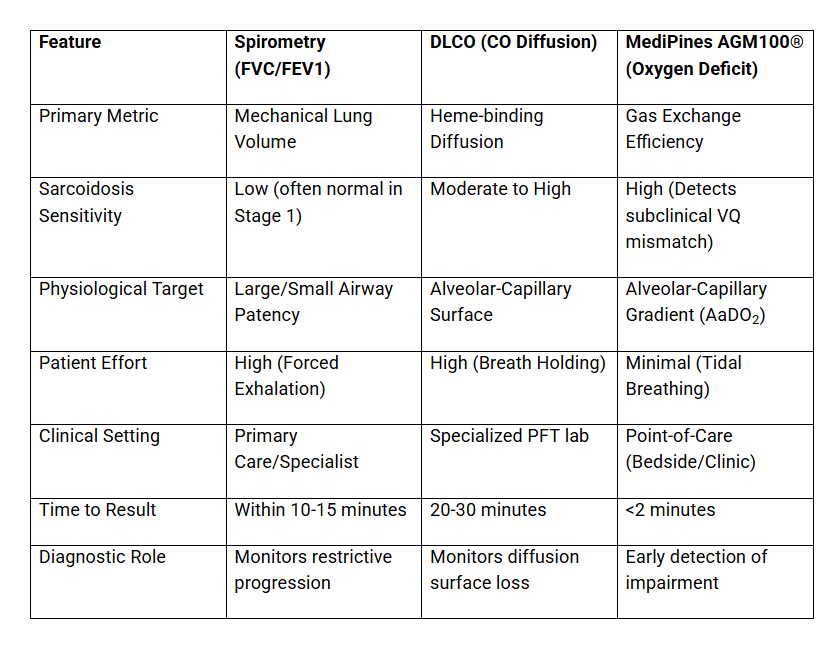
To understand where non-invasive gas exchange fits within the clinical workflow, it is essential to compare the technical strengths and limitations of current standards against newer point-of-care technology.
Technical Comparison: Pulmonary Function Modalities in Sarcoidosis Management
Limitations of Conventional Diagnostic Frameworks
Spirometry and Lung Volumes
Spirometry is a measure of mechanical function, not gas exchange efficiency. In many Stage I sarcoidosis patients, approximately 75-80% demonstrate normal FVC despite symptomatic dyspnea. Relying on restrictive patterns for diagnosis leads to significant therapeutic delays.
Radiographic Staging (Scadding Criteria)
The Scadding system is purely morphological. While HRCT improves the detection of micronodules, it cannot quantify functional impairment. A patient may present with stable Stage II imaging but experience profound exertional desaturation due to compromised gas exchange.
Arterial Blood Gas (ABG) Analysis
While the (A-aDO2) gradient is the gold standard for assessing gas exchange efficiency, the invasive nature of arterial puncture precludes its use as a routine longitudinal monitoring tool. Furthermore, the risk of arterial injury and the requirement for immediate point-of-care laboratory analysis limit its clinical throughput in outpatient settings.
Advanced Non-Invasive Assessment: The AGM100 Workflow
The integration of the MediPines AGM100® allows for the precise measurement of gas exchange efficiency using tidal breathing analysis.
The Oxygen Deficit (OD) Parameter
The AGM100 utilises a proprietary algorithm to calculate the Oxygen Deficit, defined as the difference between the partial pressure of alveolar oxygen (PAO2) and the predicted partial pressure of arterial oxygen (PaO2).
-
Mechanism: By analysing end-tidal PO2 and PCO2, in conjunction with precision pulse oximetry (SpO2), the device identifies the ‘efficiency gap’ in Oxygen transport.
-
Clinical Sensitivity: An elevated Oxygen Deficit (normal range: 0–15 mmHg) serves as a sensitive indicator of interstitial lung disease (ILD) activity, even when the patient remains normoxic at rest.
Comparison with DLCO
While Carbon Monoxide Diffusing Capacity (DLCO) is highly relevant, it requires specialized lab facilities and intense patient cooperation. The AGM100 provides a point-of-care equivalent that reflects real-time gas exchange dynamics during normal respiration, making it a viable alternative for frequent monitoring and rapid screening.
Validated Clinical Outcomes
The transition to non-invasive gas exchange monitoring is supported by substantial peer-reviewed evidence:
-
Accuracy: Validation studies established a correlation coefficient of 0.97 between the AGM100’s calculated values and traditional invasive ABG measurements.
-
Prognostic Value: Research indicates that the Oxygen Deficit is a superior predictor of clinical deterioration in respiratory patients compared to (SpO2) alone, offering an AUROC of 0.99 for predicting the need for supplemental oxygen
Clinical Integration Strategy of AGM100 for Sarcoidosis Management
For optimal management of pulmonary sarcoidosis, the following diagnostic algorithm is recommended:
-
Baseline Assessment: All suspected or confirmed sarcoidosis patients should undergo an AGM100 assessment to establish a baseline Oxygen Deficit.
-
Longitudinal Monitoring: In Stage I and II patients, non-invasive gas exchange checks can be performed frequently. An increasing OD trend should trigger HRCT imaging or treatment initiation.
-
Therapeutic Titration: The OD metric can be used to objectively measure the efficacy of anti-inflammatory treatments. A reduction in Oxygen Deficit correlates with a positive clinical response.
Conclusion: Bridging the Gap in Early Intervention in Sarcoidosis Management
The clinical objective in pulmonary sarcoidosis is to identify and treat granulomatous inflammation before it transitions into irreversible Stage IV fibrosis. However, relying on spirometry and radiography alone often leaves a “diagnostic blind spot” during the most treatable phases of the disease.
The MediPines AGM100® fills this critical gap. By providing a real-time, non-invasive assessment of the Oxygen Deficit, it allows you to quantify functional impairment that your patients are feeling, even when their lung volumes remain technically “normal.
The question is no longer if your patients have gas exchange impairment, but how early you can detect it.
Are you ready to move beyond the limitations of traditional testing? If you are managing complex ILD or sarcoidosis cases and want to see how the AGM100 can add a new layer of physiological precision to your clinic, with quick results, let’s start a conversation.
Contact us today to request a clinical demo or to review our full validation data package. Together, we can redefine the standard of care for early sarcoidosis detection.
References:

 By
By